
Beyond Us vs. Them
A Systems Approach to Moving Beyond Binary Thinking

Binary clarity is fast, but the price of speed is accuracy. When stress is high, tidy opposites flatten people, turn conditions into character, and shrink what we can do together. This slide to "us vs. them" isn't inevitable; it’s a habit built from reflexes and reinforced by systems. The burden of this mindset falls disproportionately on marginalized communities, and the tools offered here are not a substitute for systemic change or immediate safety in the face of direct violence. This essay moves beyond a simple psychological critique to examine how binary thinking functions as a powerful social tool for creating and reinforcing hierarchies. By tracing how innate biases are amplified by structured power, it shows that the "us vs. them" mindset is a design flaw that can be leveraged to justify exclusion and solidify control.
On Grief
I am writing now because suffering is immediate and shared. Hate-filled rhetoric and violent images flood our feeds. Different communities are carrying grief and anger at the same time, in different ways. Naming that is not a plea to blur specific harms or flatten history; it is a refusal to turn pain into teams. Shared trauma can trap us in parallel shock; the move is to metabolize that shock into collective grief that holds specificity, honors different experiences, and refuses to rank or erase anyone’s pain. Collective grief is not neutrality. It widens the circle instead of tightening the ranks. As Klein argues, the political task is to step out of the "mirror world" of reactive doubles and into practices that break the spell—to move from the circuitry of shared trauma to the discipline of collective grief, where we can see clearly enough to act together (Klein 2023). We do not excuse, minimize, or “understand” those causing harm. We set boundaries, name harm precisely, and act to change conditions so harm is less likely tomorrow. That is the stance: keep dignity intact, keep analysis specific, and refuse to let outrage conscript us into an “us vs. them” script that reproduces the very logic we oppose.
Why Radical Empathy Matters to Me
I practice radical empathy as a form of survival. Not to excuse harm, but to keep from letting pain turn me into the thing that hurt me. It is the choice to hold difference when my body wants armor, to stay human when punishment looks like relief. Radical empathy is not a demand on those facing harm to empathize with aggressors; it is a discipline for those in relative safety to resist reproducing punitive “us vs. them” logics, while keeping accountability intact.
Content note: brief mention of sexual violence
Nine years ago, on the night a powerful man’s words about women’s bodies were everywhere, I was raped. The person who harmed me agreed with my outrage at the headline; that agreement did not protect me. The overlap cut deeper. I’m naming this to locate my stance under pressure, not to ask for exception. When I feel myself harden, I start with small, doable moves: take three slow exhales, name what just tightened in me in five words or fewer, and swap a take for one honest question. If I have a bit more capacity, I add a simple reframe: “What else could be true here?” or “What conditions might make this likely?” Only when I’m steadier do I try a deeper exercise like imagining the person as an infant and asking, “What did this baby need that they did not get?” Sometimes the question is systemic instead: “What designs, incentives, and stories made this outcome more likely?” These questions do not undo harm or soften accountability. They keep me from letting disgust outsource my ethics (Nussbaum 2004). They turn intensity into information and point my action toward causes and choices, not labels. I try to hold a person in view while I keep boundaries intact. I look for the conditions I can change today. This isn’t softness. It’s how I stay able to act, learn, and protect what matters—without throwing “others” away.
Part I: The Roots of Human Division
This section establishes the foundational psychological and evolutionary principles that underpin social division, tracing the "us vs. them" mentality from its primal origins to its modern cognitive reinforcements. It provides a scientific basis for understanding how these deep-seated tendencies manifest in societal issues. The analysis demonstrates how these psychological mechanisms, while serving an ancestral purpose, can be manipulated and amplified in a complex world, leading to entrenched social pathologies.
The Primal Instinct: "Us vs. Them" Mentality
At its core, “us vs. them” is a human reflex shaped by evolution and social context. Social Identity Theory shows how we derive part of our self‑concept from group ties and quickly sort into in‑groups and out‑groups (Tajfel 1979). In plain terms, the theory says we boost our own group to feel good about ourselves and, without noticing, devalue or distrust “others,” which sets the stage for bias and conflict.
Historically, loyalty to small groups and caution toward outsiders could aid survival; today, those reflexes are reshaped and amplified by culture and institutions (Brewer 1999). Evolutionary psychology’s point here is simple: once‑useful shortcuts ride along in modern life, where they can be steered by stories, incentives, and design (Cosmides and Tooby 1992). That wiring shows up as cognitive shortcuts that sustain division. A central one is the tendency to explain an out‑group member’s harmful act as a fixed character flaw, while explaining the same act by someone in our group as a product of the situation (Ross 1977). This is the fundamental attribution error in action: we over‑credit traits and under‑credit context, especially for people we see as “not us.” The result is a fast double standard that feels like clarity but misreads reality (Ross 1977).
Building on that, Social Identity Theory also helps explain how blaming outsiders can boost our own group’s status, turning misjudgment into fuel for conflict (Tajfel 1979). The “just‑world” belief adds moral cover by treating harms as deserved rather than contingent or systemic (Lerner 1980). In practice, just‑world thinking is a comfort reflex: if the world is fair, then bad outcomes must be someone’s fault, which makes victim‑blaming feel like moral order while pulling attention away from conditions we could change.
Another amplifier is the “out‑group homogeneity” effect: we see “them” as all the same and “us” as diverse (Tajfel 1979). Put simply, it collapses many people into one flat stereotype, which makes empathy and problem‑solving harder. Under fear and disgust, these shortcuts become raw material for social power: cues get scripted into categories, slogans, and rules. What starts inside one body turns outward when institutions aim disgust, ration empathy, and translate blame into policy (Rozin et al. 2000). Together, these dynamics create a kind of triple‑lock: blame feels emotionally tidy and morally comfortable while attention is pulled away from systemic causes (Ross 1977).
The Cognitive Shortcuts of Prejudice: Biases That Perpetuate Division
The instinctual drive to form in-groups and out-groups is systematically reinforced by an array of cognitive biases—the brain's mental shortcuts. These heuristics were developed to manage "too much information" and facilitate quick decisions when time and resources are limited. While often efficient, these shortcuts are prone to predictable errors in judgment that can lead to unfair, self-serving, and counter-productive outcomes (Kahneman 2011; Ross 1977). These biases are a critical component in the perpetuation of social division.
Confirmation Bias: Individuals have a natural inclination to seek out information that supports their pre‑existing beliefs while dismissing evidence that contradicts them. This pattern narrows attention and hardens stances by filtering out opposing views (Kahneman 2011). In practice: your feed feels “balanced” because it matches you, not reality, locking in certainty.
Out‑Group Homogeneity Effect: People tend to see members of an out‑group as “all the same,” while recognizing nuance and diversity within their own group. This shortcut dehumanizes the out‑group and makes empathy harder (Tajfel 1979). In practice: “they” get one story and one face, which makes punitive answers feel simpler than contact.
Actor‑Observer Bias: We explain our own negative actions as products of the situation, but explain others’ similar actions—especially those in an out‑group—as evidence of a fixed character flaw. Combined with the “just‑world” belief, this overemphasizes personal choice and understates situational causes (Ross 1977; Lerner 1980). In practice: “I was rushed; they’re careless,” which points blame at people and away from fixable conditions.
Group Polarization: When like‑minded people deliberate together, their views tend to move toward more extreme positions, deepening divides over time (Sunstein 2009). In practice: agreement escalates confidence, confidence accelerates language, and language hardens into identity and policy.
The self‑perpetuating nature of social division looks like a cycle: the “us vs. them” reflex prepares the ground, and these cognitive shortcuts fertilize it so division takes root and grows. The reflex is not constant; it can be turned up or down by context such as stress, cues, and incentives (Kahneman 2011). The deeper problem is not only conflict’s outcomes but the simplification habit itself—the slide into “good vs. bad” stories that strip away causes and trade accuracy for speed (Kahneman 2011).
The Social Construction of Division
Beyond the psychological, binary thinking functions as a powerful social tool for creating and reinforcing hierarchies. What follows: how binary labels get built, then how they harden into hierarchy. These binaries are not natural laws; they are social constructs framed as absolute and unchanging opposites (Butler 1990). Common dichotomies—such as straight/gay, able‑bodied/disabled, and white/Black—flatten the complexity of human identity. By forcing people into two categories, we erase those who do not fit neatly, including multiracial and nonbinary people (Fausto‑Sterling 2000).
This construction is strategic: dominant groups are associated with valued traits while subordinate groups are defined as their opposites and linked to less valued characteristics (Butler 1990; Sedgwick 1990). At ground level, the hierarchy shows up in ordinary settings. A familiar cultural example is “men are from Mars, women are from Venus,” which uses a simple binary to assign gendered stereotypes and erase shared human qualities (Butler 1990). A post‑structuralist lens on binary opposition shows these pairs are not merely different; they are often hierarchical, with one pole assuming dominance over the other (Derrida 1976). Institutions, including schools, can reinforce reductive binaries by over‑emphasizing right/wrong outcomes, which narrows inquiry and stifles creativity (hooks 2000).
The consequence is that binary constructs become conceptual foundations for systemic oppression. Systemic racism, for example, is not just a collection of individual biases; it is embedded in laws, policies, and entrenched beliefs (Omi and Winant 2014). The “white vs. Black” binary hardens an out‑group and reinforces stereotypes and the out‑group homogeneity effect (Tajfel 1979). That social belief then justifies structural inequities, including residential segregation (Massey and Denton 1993). It also fuels gerrymandering and unequal access to wealth and opportunity (Stephanopoulos and McGhee 2015). In practice, the social and psychological functions of the binary work together: cognitive shortcuts provide the rationale, and structures turn that rationale into rules and outcomes.
From Innate Bias to Systemic Order: The Institutional Amplification of Division
The brain’s innate shortcuts are not isolated; they are the raw material for political systems of control. Authoritarian movements deliberately amplify the us–them reflex by activating five situational switches at once. When these switches are dialed up, attention narrows, disgust is moralized, and punitive options feel like clarity (Kahneman 2011). When the us–them reflex fires, the tightening in the body isn’t failure; it’s information. I’ve found that if I name it, regulate a little, and ask one systems question, a lower‑harm next step often becomes visible. Authoritarian strategies often stack these switches simultaneously—manufacturing scarcity, inflaming grievance, and leveraging media design to convert private bias into scalable social force.
The control panel: five situational switches
Manufacturing Scarcity: Authoritarianism thrives by exaggerating a real or perceived scarcity of jobs, safety, or status. This tactic exploits realistic group conflict, where scarcity cues elevate intergroup threat and competition (Sherif 1961). The result is a justification for exclusion and a desire to discipline “enemies of convenience” (Arendt 1951).
Heightening Identity Salience: Authoritarian leaders use dog whistles and grievance cues to make one social identity more central in the moment. This leverages Self‑Categorization theory: when identity is salient, people shift from a personal to a group identity, increasing in‑group favoritism and out‑group bias (Turner et al. 1987). The effect mobilizes punitive solidarity and turns a population into a unified, reactive front (Altemeyer 2006).
Controlling the Narrative: Through headlines, speeches, and memes, these movements prime a population with us‑versus‑them cues. Repeated “narrative priming” maintains a rolling “emergency” that polarizes attitudes, reduces openness to counter‑evidence (Entman 1993), and normalizes exceptional measures that erode democratic norms (Arendt 1951).
Inducing Physiological States of Stress: Authoritarianism creates ambient fear and fatigue through spectacle, chaos, and sleep loss. Chronic stress and arousal narrow attention and shift cognition toward fast, punitive heuristics; bodies under load revert to reactive modes (Menakem 2017). Populations under strain become more susceptible to simple, fear‑based messages.
Exploiting Platform Design: Modern platforms magnify these reflexes with features like anonymity, scorekeeping, and speed that reward outrage. This algorithmic architecture systematizes the brain’s shortcuts, turning private bias into public virality (Tufekci 2017). Falsehood tailored to these shortcuts travels faster and farther than truth, transforming perception into an external, self‑reinforcing order (Vosoughi et al. 2018).
From Disgust to Rule: How a Feeling Becomes Policy
The moment a private feeling of disgust is moralized into a sense of social threat is what we call social abjection—a gut-level recoil from what is judged "out of place" in the body or the world (Kristeva 1982). Here, we follow how that feeling is narrated, codified, and administered as policy—and why that process reproduces hierarchy (Tyler 2013; Nussbaum 2004).
Once moralized, a private feeling is narrated as contamination or danger. This story supplies a powerful frame that justifies intervention, setting the stage for institutional rules. The translation of a moralized story into institutional form is codification. It appears in membership criteria, exception clauses, and enforcement guidance that specify who belongs, on what terms, and at what cost. Seemingly neutral instruments—budgets, eligibility forms, and policing protocols—are the means by which a boundary becomes routine. They don't just apply a rule; they shape our perception by making the division actionable and visible in everyday life.
With repetition, this process naturalizes the binary it enforces. The presence of the rule in forms, checkpoints, and patrols trains attention to expect and then “discover” the same division. This creates a loop in which a formal structure reproduces the very feeling that birthed it. Purity politics is the doctrinal expression of this loop: a demand for homogeneity that turns private recoil into a public membership test, treating exclusion as hygiene and difference as defilement (Nussbaum 2004; Tyler 2013). The outcome isn't neutral ordering but stratification—legal, spatial, and fiscal—that is then mistaken for common sense.
Part II: The Social Manifestations of Division
The psychological underpinnings of binary thinking from Part I do not exist in a vacuum; they manifest in real-world social and political structures with powerful and enduring consequences. By reducing complex issues to simplistic oppositions, these frameworks prevent meaningful solutions and instead create a feedback loop of blame and division that perpetuates human suffering and maintains power.
The Embodiment of Trauma and Division
The experience of social division is not only intellectual or emotional; it is physiological and held in the body. Trauma—whether from personal harm or the collective weight of oppressive systems—shows up as tension, dysregulation, and chronic high arousal in the nervous system (Menakem 2017; McEwen and Stellar 1993; Sapolsky 2004). The body, where survival circuits live, triggers fight, flight, or freeze responses that reprioritize speed over nuance (LeDoux 1996; Porges 2011). Under chronic stress, prefrontal functions narrow and reactive modes take over, which can bias cognition toward fast, binary judgments (Arnsten 2009; Kahneman 2011).

The “tightening in your body” is not an overreaction; it is information about your state. The ability to read, regulate, and then choose is a privilege—it depends on safety, resources, and freedom from chronic threat. This kind of regulation is also a shared activity, cultivated and sustained by community. A shared lens on embodied trauma helps explain why suffering, though differently experienced, is widely distributed. This perspective supports naming harm and holding accountability while recognizing a shared vulnerability that can ground collective grief and coordinated change (Menakem 2017)
The Blame and Shame Economy
It’s easy to see why we turn to blame. Under pressure, it feels like a fast, tidy solution that finds a culprit and gives us closure, even if it ignores the conditions that made a problem likely. When “who did this?” becomes the only question we’re asking, analysis collapses into quick verdicts and the same scene repeats (Kahneman 2011).
Shame completes this circuit. It works like a quiet operating system that makes us internalize a broken system’s failures as our own—a pattern we can name as systemic shame (Price, 2024). The narratives feel familiar: if you can’t keep up, you must not have worked hard enough; if you’ve struggled, you didn’t care enough. This personalization keeps us from seeing the full picture. It makes dissent feel like confession and recasts redesign as excuse, so we self‑police, hide needs, and withdraw from feedback—the very dynamics that keep systemic causes unexamined (Price 2020; Mullainathan and Shafir 2013).
You can spot this blame‑and‑shame logic a few ways. Look for language that labels and fixes a person in place, moral tones that turn mistakes into a measure of character, and abstractions that treat friction as if it were a choice. You can also spot it in the speed of a verdict—the faster the judgment, the thinner the account of conditions (Lerner 1980).
A gentler premise is also possible: mistakes are information—they point to design flaws, missing buffers, poor timing, or hidden constraints. Shifting attention from what’s “wrong” with a person to what’s “off” in the conditions doesn’t let anyone off the hook; it restores accuracy. It moves the conversation from “what kind of person would do this?” to “what made this predictable here?” and “what, if altered, would make a different outcome likely next time?” (Kahneman 2011; Lerner 1980).
The difference between charity and mutual aid clarifies this logic. Charity assigns worth and dispenses help conditionally, reinforcing ranks and dependence. Mutual aid names shared need, builds reciprocal capacity, and refuses the story that scarcity is a personal flaw. Charity narrows belonging to those who “deserve” help; mutual aid widens belonging by practicing it in common (Spade 2020; Price 2020).
Ultimately, the point is not softer judgment but better sight. When blame and shame are in charge, thinking shrinks, language stiffens, and harm repeats. When we refuse to moralize scarcity and treat mistakes as signals, analysis regains depth. That is the turn that matters: from personas to patterns, from recurrence to learning (Price 2020; Mullainathan and Shafir 2013).
Market justice vs. social justice
Some conditions are systemically impacted in how we organize essentials. “Market justice” treats basic needs as commodities distributed by ability to pay; “social justice” treats them as rights grounded in need and fairness. Framed as a clean either/or, this sells false tradeoffs: market efficiency alone does not deliver shared security, while social guarantees without design rigor can underperform if incentives are ignored. The practical stance is twofold: constrain extraction where markets strain the vulnerable, and provision baselines that de‑leverage scarcity. In U.S. healthcare, market justice predictably yields unequal distribution and worse outcomes for vulnerable groups, underscoring that “neutral” market logics are moral frameworks, not technical fixes (Braveman et al. 2011; Daniels 1985).
The psychological tendency to simplify the world into binaries shows up in large‑scale debates about distribution and fairness. In many societies, this gets framed as a conflict between market justice and social justice, not just as policy difference but as a clash of worldviews about individualism and collectivism.
Market justice emphasizes individual responsibility, competition, and efficiency. Goods and services—including healthcare—are treated as commodities, and access tracks purchasing power.
Social justice emphasizes collective responsibility, equity, and a longer time horizon. Essentials are basic rights; distribution tracks need and fairness rather than wealth.
In practice, markets tend to prioritize near‑term, individual outcomes, while social justice aims at longer‑term, collective outcomes. That mismatch isn’t just a policy disagreement; it’s part of a broader habit of flattening complexity into binaries. When shame and blame fixate us on culprits, “purity” politics often pushes us to double down, punishing nuance and casting empathy as betrayal. “Moderate centrism” isn’t neutral either; it can preserve the status quo by averaging extremes instead of changing conditions. There is another path: stay anchored to dignity and non‑harm, and adjust language, workflows, and everyday setups so harm drops for everyone. In practice, that looks like pausing long enough to choose instead of react, naming harm without collapsing a life into a label, and making one concrete change so the same miss is less likely tomorrow. The payoff is clarity with care, and progress without throwing anyone away.
From Purity to Capacity
Purity frames safety as removal. If something feels out of place—a person, a need, a sign of struggle—the answer is to get it out. This approach starts with a private, gut-level feeling of abjection—a "push away" from what feels leaky or contaminated (Kristeva 1982). Because disgust is so often read as moral, the act of "clean-up" can sound like care while doing the work of exclusion. The result is tidy rules that shrink belonging and make harm feel like hygiene. We inherit environments where the quickest path to order is removal, interrupting any fantasy of a smooth flow.
This process is visible at any threshold. Doorways, waiting rooms, and queues are designed pauses where bodies are read and given an instruction about who belongs, for how long, and at what cost. Small choices at these thresholds can scale abjection: a sign that presumes risk, a line that forces jostling, or "safety" that performs suspicion. These aren’t décor; they are the moments where abjection travels quickly from sensation to a rule, where the promise is tidiness and the result is hierarchy (Tyler 2013). This institutional translation makes exclusion appear natural and necessary.
In contrast, capacity is a practical alternative. It widens attention, restores specificity, and changes one condition so exclusion is no longer mistaken for clarity. This counter-design operates on two intertwined principles. Integration re-opens contact and conditions by changing a local setup to make the next crossing workable—like "privacy-by-default bathrooms" or queues that prevent forced jostling. At the same time, alterity protects difference without absorption, ensuring we meet others as full subjects, not symbols to fix or absorb. This discipline to "hold difference" builds arrangements where choice, contact, and protected difference can coexist.
Used together, these principles convert the abjection reflex into workable crossings. Purity promises tidiness and produces hierarchy; capacity builds arrangements where choice, contact, conditions, and protected difference can coexist (Kristeva 1982; Nussbaum 2004; Tyler 2013). But moving from theory to practice requires confronting a powerful habit: the comfort of finding a culprit. The habit of naming a culprit is strong; it feels decisive and fair. But individual acts unfold inside structures that distribute risk, information, and power unevenly. If we don't shift our analysis to rules and systems, we reproduce disadvantage.
So if the systems are stacked to moralize disgust and naturalize exclusion, what do we do? We don’t have to surrender. The way out is not a new theory but a new practice. Read the moment for conditions, not culprits, and try one small change you can make today. Part III offers practices I return to when pressure is high—not rules, but a compass for finding a steadier next step without waiving accountability.
Part III: A compass for navigating conflict
When pressure spikes, clarity shrinks and punishment feels efficient. This section is a field playbook to counter that slide in real time. The tools are short, stackable, and designed to be used in under five minutes at the point of strain—in a meeting, a group chat, or a hallway. They turn high arousal into usable attention so we can choose instead of react. They bring a person—not a category—back into view without waiving accountability. And they change one concrete condition so the same miss is less likely tomorrow. Run them by keeping it tiny: one breath, one sentence, one setup change. Stop as soon as the next step feels lighter or kinder for everyone.
When to use them: Use a tool the moment you feel your focus tunneling or language hardening into labels, when blame is loud and time is short, or when scarcity or speed makes punitive options look like clarity.
Guardrails: Dignity is non-negotiable—no incitement, no dehumanizing labels. Accountability remains—name impact plainly and set boundaries. Favor specificity over verdicts—describe the setup, not a persona.
How to run them: Move through the Three Moves—Downshift, Humanize, Provision—as capacity allows. If blame is dominating the conversation, switch to the Ladder to redirect energy from “who” to “what made this likely.”
Safety First
The first step in any high-stakes situation is to secure your safety and the safety of others. The Three Moves are not for moments of immediate physical danger. Use them after the threat has passed, or for navigating high‑pressure ideological and relational conflicts where physical safety is not in immediate question.
The Three Moves: A Framework for Real-Time Intervention
The transition from a diagnosis of division to a practical solution begins with three linked, real-time interventions. The brain's predictable failure modes under pressure—arousal, dehumanization, and manufactured scarcity—can each be countered with a concrete, corrective move.
Downshift: This practice is a form of physiological integration designed to interrupt high-arousal states. When the body is in a state of stress, attention narrows and punitive shortcuts appear as clarity. The downshift practice, which includes techniques such as exhaling longer than inhaling for a few breaths, widens attention and restores the capacity for choice. It is a physiological prerequisite for any other intervention; a mind hijacked by adrenaline cannot engage in a nuanced response.
Humanize: This move is an act of relational integration that counters the dehumanizing effects of binary thinking and the fundamental attribution error. It requires the deliberate choice to hold a specific person in view, rather than a category or stereotype. In practice, this involves asking one honest question, naming impact in plain words, and restating a boundary—naming harm without collapsing a person's life into a label.
Provision: This move is a form of systemic integration that counters the effects of manufactured scarcity and the blame-and-shame economy. It involves changing one concrete condition that keeps pressure high and makes punitive options look like the only shortcuts.
The practices of Downshift, Humanize, and Provision are designed to work in concert, creating a complete workflow that moves from internal regulation to relational repair and finally to systemic adjustment.
The Ladder: From “Who” To “What Made This Likely”
The Blame → Systems Ladder is a rapid reframing tool for moments when blame is loud and time is short. Its purpose is to counter the fundamental attribution error by forcing a conscious shift from judging character to analyzing conditions (Ross 1977). By deliberately moving up its rungs, this tool helps us resist the emotional clarity of "individual blame logic" and instead locate the design, rule, or incentive we can change today (Lerner 1980). The Ladder is a diagnostic and an antidote. Start at the the “person” rung to honor immediate accountability, then deliberately widen the frame until you find a systemic point of leverage.
Usage note: The Ladder is for sense‑making and analysis, not immediate crisis response. In the face of direct harm, the Person rung is about honoring accountability and taking a firm stand; deeper analysis can come later.
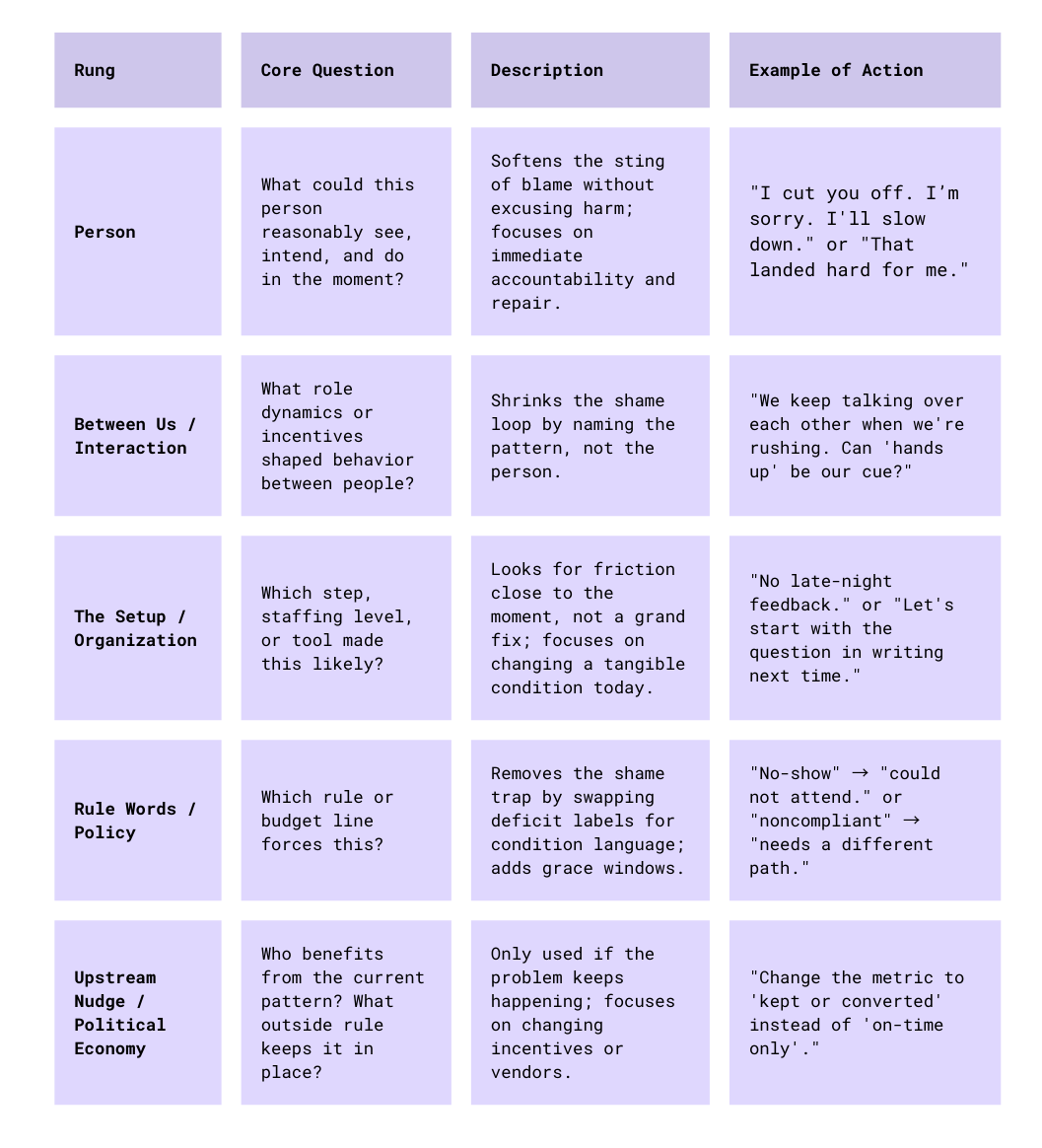
The Ladder is not just a list of questions; it's a way to read systemic signals. When you see the same miss repeated across different people or teams, it’s a clear signal to climb the ladder faster, bypassing the Person rung and moving straight to Organization or Policy. Similarly, if multiple people report the same constraint, treat it as a design flaw, not a personal failing.
Bias Interrupters
Use these when you feel attention tightening. Each is fast, concrete, and designed to bring choice back online before you speak, post, or decide.
90‑second reframe
Exhale longer than inhale for 4 breaths.
Name the trigger in 5 words or fewer.
Ask one systems question: “What conditions could produce this?”
Choose a next action that reduces harm or increases information.
Counter‑stereotype visualization: For 60–90 seconds, vividly imagine a respected in‑group member praising an out‑group individual for excellence in the exact domain your bias targets. Add sensory detail. Repeat before high‑stakes interactions.
“Name it to tame it” interpersonal script: Use a neutral, accountable sentence stem to slow escalation: “I notice I’m going into ‘us–them’ thinking and I could be missing context. Can we pause and add one systems factor before we decide?”
Language that defuses shame without excusing harm
“I’m not proud of how I said that. Let me try again.”
“I hear the impact. I want to make it easier next time.”
“I think the setup made this likely. Can we move one thing?”
“I felt cornered and got sharp. I’m adding a pause cue for myself.”
Why this works for shame-and-blame
It gives the body a place to go (repair) and the moment a way out (one small change) without turning anyone into the problem.
It protects dignity while still changing behavior and conditions.
Use these tools to climb from person to policy without skipping context. It’s a rapid reframing tool for moments when blame is loud and time is short. Start at the person level to honor accountability, then deliberately widen the frame until you locate the design, rule, or incentive you can change today.
Part IV: The Future: A Blueprint for Interdependence and Capacity Building
Moving beyond binary thinking is not an idea to admire; it is a practice to inhabit. The shift from an “us vs. them” worldview to interdependence lives in concrete choices that link personal healing to systemic change. This final part is a practical roadmap for that linkage. It argues that inner work is not private virtue but shared infrastructure for action, and that the conditions we design together either make care easier than punishment or the reverse. Part III gave us moves for the moment. Part IV builds the capacities and arrangements that make those moves ordinary—a blueprint for interdependence we can actually inhabit.
The Interconnected Self: From Individualism to Interdependence
The hyper‑individualistic image of the person—stable, self‑sufficient, autonomous—cannot carry the weight of real life. Relational psychology argues the self is co‑authored in context (Gergen 2009). If selves are made in relation, power maps those relations. Intersectionality shows how.
Intersectionality, a term coined by Kimberlé Crenshaw to describe how different forms of social inequality interact and compound each other. Intersectionality moves beyond a simple binary analysis of identity (e.g., male/female, white/Black), which erases those at the intersections of multiple marginalized groups. A woman of color experiences racism differently than a man of color, just as she experiences sexism differently than a white woman. As practice, this lens builds flexible solidarity and forces movements to confront structural and direct violence as indivisible struggles. As a practical tool, it forces movements to confront violence and oppression as indivisible struggles.
Intersectionality provides the analytical clarity to see the complex, overlapping systems of oppression. The concept of the relational self provides the emotional basis for understanding that we are all interwoven with one another. And emergent strategy provides the practical philosophy for how to act on this understanding in a non-linear, adaptive way (brown, 2017). This triad serves as the blueprint for building a society rooted in interdependence rather than separation.
Inner Work That Sustains Outer Change
A central, recurring theme is the intimate connection between the inner work of personal well-being and the outer work of cultivating social and political change. Focusing only on external, systemic change can be insufficient because it risks perpetuating the deeply ingrained patterns of unhealed trauma that reside within individuals and organizations. Systems are not impersonal constructs; they are made up of the relationships between people, which means the relationship between inner and outer work is not oppositional but generative, with each process powerfully empowering the other (Haines 2017). Personal healing is not a self-indulgent luxury but a necessary precondition for sustained, effective action (Menakem 2017).
The analysis indicates that systemic trauma responses mimic individual trauma responses. When individuals in positions of power operate from a place of unhealed trauma—expressing patterns like blaming, controlling behavior, or dehumanization—the systems they influence will mirror these same responses. This creates a vicious cycle where the system, burdened by unhealed relationships and unresolved conflict, re-traumatizes the very people it is meant to serve.
With the ground set—relational selves, an intersectional lens, and inner capacity—the next step is skill. We begin by training empathy and designing embodied practices that can hold under strain. Empathy, which helps loosen “us vs. them,” can be strengthened through deliberate practice, such as empathy exercises and active listening, to foster shared understanding of diverse experiences (Decety and Jackson 2004). This builds the interpersonal capacity needed to navigate conflict. We then connect this to collective action through mutual aid networks and advocacy, which build community power and meet needs by addressing systemic failures (Spade 2020).
Somatic Practices that Stabilize Action
When connection work gets real, our bodies still need support. The trauma of living under systems of oppression is not abstract; it is held in the body, manifesting as tension, dysregulation, and a perpetuation of harmful survival mechanisms. These practices steady the nervous system so our skills don’t collapse under load.
Somatic practices, which are holistic methods that engage a person's thinking, feeling, sensing, and actions, offer a path to healing this collective trauma (Haines 2017). Practices such as breathwork, body scanning, and grounding techniques serve as a vital toolkit for regulating the nervous system and releasing stored stress. They help individuals move beyond a reactive, survival-based state into a more grounded presence. Social Justice Somatics applies this embodied transformation to the political project, arguing that healing from trauma frees up creativity and deepens the capacity for empathy and bold collective action (Haines 2017; Menakem 2017). By embodying new ways of being that are aligned with values of collaboration and solidarity, even under pressure, activists are better equipped to build movements that are not only strategically wise but also relationally and emotionally
The work of cultivating inner capacities like courage and empathy provides the strength and resilience for the long-term struggle of systemic change. In return, engaging in a collective project for justice, such as a mutual aid network or a movement for change, provides a profound sense of belonging and connection, which combats the isolation and trauma experienced in fragmented societies. This is a powerful feedback loop where personal healing creates the capacity for collective action, and collective action, in turn, provides the context for deeper personal healing.
This inner work involves cultivating a deeper awareness of one's own unconscious trauma responses. Practices such as meditation, mindfulness, and somatic practices are modes of embodied social change that can help individuals become more grounded, self-aware, and resilient (Haines 2017; Menakem 2017). This is crucial for moving away from the rationalistic, power‑over systems that have historically perpetuated oppression.
Holding Each Other Across Difference
What if our first reflex, under pressure, was to widen the circle instead of tighten the ranks? Not to agree, not to excuse, but to hold. To hold is to keep a person in view while we keep our boundaries intact. It is to stay with the full picture long enough to see causes and choices, not just labels. And it is to keep dignity non-negotiable while curiosity opens a path forward.
Imagine a town hall where the most affected speak first and the rest of us practice listening that repairs. A school where a hallway gets redesigned before a child gets renamed as a problem. A workplace where we replace “who messed up?” with “what made this likely?” and then fix that. Collective holding looks ordinary up close: a breath long enough to keep choice online, one question that turns a category back into a person, and one condition changed today that lowers the temperature for everyone.
We won’t agree on everything. We don’t have to. If we can hold each other across difference, we can argue policy without exile, protect each other without punishment as a default, and win real improvements without throwing anyone away. That’s not softness. That’s courage aimed at the future we actually want.
Navigating the Pushback: Addressing Common Objections
This approach—while principled—is not without its critics. It often faces pushback from those who are more comfortable with the status quo, which is why it's essential to address these common objections directly. One frequent critique is that this framework is simply a form of "moderate centrism" that averages out extremes. That’s inaccurate. Moderate centrism often protects the status quo by splitting the difference. This approach is different: it holds principles, not people, and focuses on changing conditions and levers of power so harm drops and clarity rises. Another common objection is that this work is "soft" or that empathy "lets people dodge accountability." This is not a call for softness. Accountability stays. We name impact in plain words, make specific repairs, keep boundaries intact, and fix the conditions that made the harm likely in the first place. The goal is dignity plus change: protect people’s worth while changing behavior and the setups that drive repeats.
Conclusion: From Separation to Solidarity
The "us vs. them" reflex is not destiny; it’s a design flaw. It starts in bodies under load, is simplified by cognitive shortcuts, and gets amplified by institutions and platforms that reward outrage. The antidote is practiced interdependence: steadier nervous systems, wide sightlines that hold overlapping truths, and arrangements that make contact safer than punishment.
This work is concrete and repeatable. We regulate enough to choose. We humanize without waiving accountability. We change one condition so the same miss is less likely tomorrow. Paired with intersectionality and mutual aid, these moves scale from moment to culture, turning blame into learning and scarcity into shared capacity.
I practice these moves because I need them to keep acting without throwing anyone away. If one person can use them to heal and orient in the middle of conflict, what could we build together with them? A culture that treats dignity as non‑negotiable, changes conditions instead of hardening labels, and makes contact safer than punishment. That future is not abstract; it’s the next small change we choose—and choose again—until it becomes ordinary.
Works cited
Altemeyer, Bob. 2006. The Authoritarians. Self-published.
Arendt, Hannah. 1951. The Origins of Totalitarianism. New York: Harcourt Brace Jovanovich.
Bail, Christopher A. 2021. Breaking the Social Media Prism: How to Make Our Platforms Less Polarizing. Princeton, NJ: Princeton University Press.
Braveman, Paula, Susan Egerter, and David R. Williams. 2011. “Health Disparities and Health Equity: The Issue Is Justice.” American Journal of Public Health 101 (S1): S149–55.
Brewer, Marilynn B. 1999. “The Psychology of Prejudice: Ingroup Love and Outgroup Hate?” Journal of Social Issues 55 (3): 429–44.
Brown, Adrienne Maree. 2017. Emergent Strategy: Shaping Change, Changing Worlds. Chico, CA: AK Press.
Butler, Judith. 1990. Gender Trouble: Feminism and the Subversion of Identity. New York: Routledge.
Cosmides, Leda, and John Tooby. 1992. “Cognitive Adaptations for Social Exchange.” In The Adapted Mind: Evolutionary Psychology and the Generation of Culture, edited by Jerome H. Barkow, Leda Cosmides, and John Tooby, 163–228. New York: Oxford University Press.
Crenshaw, Kimberlé. 1989. “Demarginalizing the Intersection of Race and Sex: A Black Feminist Critique of Antidiscrimination Doctrine, Feminist Theory and Antiracist Politics.” University of Chicago Legal Forum 1989 (1): 139–67.
Daniels, Norman. 1985. Just Health Care. Cambridge: Cambridge University Press.
Decety, Jean, and Philip L. Jackson. 2004. “The Functional Architecture of Human Empathy.” Behavioral and Cognitive Neuroscience Reviews 3 (2): 71–100.
Entman, Robert M. 1993. “Framing: Toward Clarification of a Fractured Paradigm.” Journal of Communication 43 (4): 51–58.
Gergen, Kenneth J. 2009. Relational Being: Beyond Self and Community. New York: Oxford University Press.
Haines, Staci K. 2019. The Politics of Trauma: Somatics, Healing, and Social Justice. Berkeley, CA: North Atlantic Books.
harvey, David. 2005. A Brief History of Neoliberalism. Oxford: Oxford University Press.
hooks, bell. 2000. All About Love: New Visions. New York: William Morrow.
Kahneman, Daniel. 2011. Thinking, Fast and Slow. New York: Farrar, Straus and Giroux.
Klein, Naomi. 2023. Doppelganger: A Trip into the Mirror World. New York: Farrar, Straus and Giroux.
Kristeva, Julia. 1982. Powers of Horror: An Essay on Abjection. New York: Columbia University Press.
Lerner, Melvin J. 1980. The Belief in a Just World: A Fundamental Delusion. New York: Plenum Press.
Menakem, Resmaa. 2017. My Grandmother’s Hands: Racialized Trauma and the Pathway to Mending Our Hearts and Bodies. Las Vegas, NV: Central Recovery Press.
Mullainathan, Sendhil, and Eldar Shafir. 2013. Scarcity: The New Science of Having Less and How It Defines Our Lives. New York: Times Books.
Nussbaum, Martha C. 2004. Hiding from Humanity: Disgust, Shame, and the Law. Princeton, NJ: Princeton University Press.
Price, Devon. 2020. Laziness Does Not Exist. New York: Atria.
Price, Devon. 2022. Unmasking Autism: Discovering the New Faces of Neurodiversity. New York: Harmony.
Ross, Lee. 1977. “The Intuitive Psychologist and His Shortcomings: Distortions in the Attribution Process.” In Advances in Experimental Social Psychology, Vol. 10, 173–220. New York: Academic Press.
Rozin, Paul, Jonathan Haidt, and Clark R. McCauley. 2000. “Disgust.” In Handbook of Emotions, edited by Michael Lewis and Jeannette M. Haviland-Jones, 637–53. New York: Guilford Press.
Sedgwick, Eve Kosofsky. 1990. Epistemology of the Closet. Berkeley: University of California Press.
Sherif, Muzafer. 1961. Intergroup Conflict and Cooperation: The Robbers Cave Experiment. Norman, OK: University Book Exchange.
Spade, Dean. 2020. Mutual Aid: Building Solidarity During This Crisis (and the Next). London: Verso.
Stephan, Walter G., and Cookie White Stephan. 2000. “An Integrated Threat Theory of Prejudice.” In Reducing Prejudice and Discrimination, edited by Stuart Oskamp, 23–45. Mahwah, NJ: Lawrence Erlbaum Associates.
Sunstein, Cass R. 2009. Going to Extremes: How Like Minds Unite and Divide. New York: Oxford University Press.
Tajfel, Henri. 1979. “Individuals and Groups in Social Psychology.” British Journal of Social and Clinical Psychology 18 (2): 183–90.
Tufekci, Zeynep. 2017. Twitter and Tear Gas: The Power and Fragility of Networked Protest. New Haven, CT: Yale University Press.
Turner, John C., Michael A. Hogg, Penelope J. Oakes, Stephen D. Reicher, and Margaret S. Wetherell. 1987. Rediscovering the Social Group: A Self-Categorization Theory. Oxford: Blackwell.
Tyler, Imogen. 2013. Revolting Subjects: Social Abjection and Resistance in Neoliberal Britain. London: Zed Books.
Vosoughi, Soroush, Deb Roy, and Sinan Aral. 2018. “The Spread of True and False News Online.” Science 359 (6380): 1146–51.
Your works cited at the end of your articles makes me feel like I'm not doing enough. I love it.